Thursday, September 10, 2020

Most Obamacare health insurance co-ops shut down

A Fortune article reports that soon only 3 of the 26 "co-ops" created will remain. The rest were or will be shut down due to financial failure. I suspect the federally-run "marketplace," healthcare.gov, is not one of the 26. It is not one of the 3.

A major feature of Obamacare was health insurance "co-ops" or "exchanges" or "marketplaces" where people could purchase subsidized health insurance. The buyer could not be denied coverage for health-related reasons and obtain a policy from a private health insurance company. The health insurance company is subsidized by government. The buyer might also get a subsidy from the federal government to help pay the premium. 

Premium amounts could not be based on pre-existing conditions, health status, claims history, duration of coverage, gender, or occupation. They could only vary by age, smoker/nonsmoker, and geographical region. More details are here.

Due to the large majority of working people getting health insurance via their employers, the individual health insurance market for people less than age 65 is small. For this reason alone, it is difficult for an insurer to charge premiums high enough to cover claims, even with being able to (1) not accept higher risks and/or (2) charging higher premiums to higher risk people. Also, if a person can pay a smaller premium by passing a health exam given by an insurer off the exchange, why would that person buy on the exchange? The effect is that only higher risk persons buy on the exchange. Adding to the problem by outlawing #1 and #2 and an inadequate government subsidy make it even more financially difficult for the insurer, and the result is Obamacare "exchanges." That is what health insurers face on the "exchanges." It is a recipe for financial failure.

Monday, September 7, 2020

Coronavirus - remdesivir #2

 A Wall Street Journal article says that nearly three dozen attorneys general are attempting a legal act of theft of Gilead's patent on remdesivir. Since the article is behind a paywall, the following are some excerpts.

The attorneys general effectively assert that remdesivir belongs to the government because taxpayers helped fund its development. 

First, Gilead’s scientists are entirely responsible for the invention of remdesivir.

The government didn’t get involved until later, when it teamed up with Gilead to test whether the drug was effective against Ebola. 

Later, Gilead collaborated with academic and government institutions to test remdesivir against coronaviruses like SARS and MERS. But the total government expense for research adjacent to remdesivir, about $70 million, is a fraction of the more than $1 billion Gilead has committed to the drug. 

Friday, September 4, 2020

Coronavirus -- HCQ, RCT, politics

This article, title Hydoxychloroquine: A Morality Tale, is sort of long (> 15,000 words), but well worth reading. It is about the drug (HCQ), randomized control trials (RCT), facing a pandemic due to a novel virus, and how they have been so politicized.

Remdesivir has been politicized, too, but not as much. Many people on the political left favor it. Its success in treating Covid is modest. Some had a change of heart when they assumed the FDA was unduly influenced by the Trump administration when the emergency use authorization was broadened for remdesivir. See my September 1 post.  

The article gets philosophical: "We live in a culture that has uncritically accepted that every domain of life is political, and that even things we think are not political are so, that all human enterprises are merely power struggles, that even the idea of “truth” is a fantasy, and really a matter of imposing one’s view on others. For a while, some held out hope that science remained an exception to this. That scientists would not bring their personal political biases into their science, and they would not be mobbed if what they said was unwelcome to one faction or another. But the sordid 2020 drama of hydroxychloroquine—which saw scientists routinely attacked for critically evaluating evidence and coming to politically inconvenient conclusions—has, for many, killed those hopes." 


Wednesday, September 2, 2020

Coronavirus -- NY Times biased statistic

Yesterday's The New York Times here included the following by David Leonhardt.

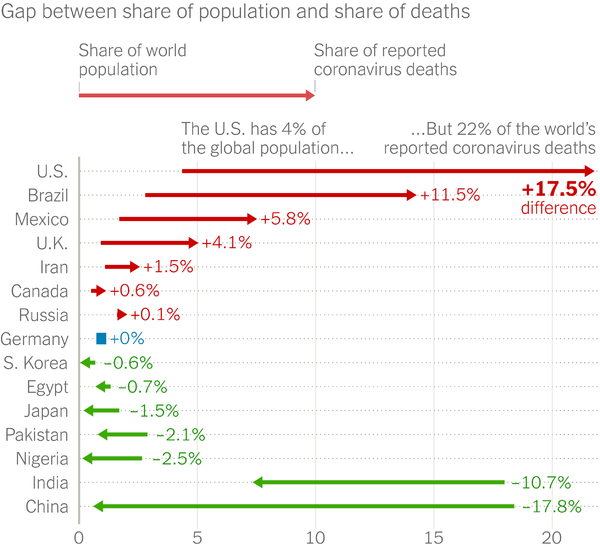
Here’s a jarring thought experiment: If the United States had done merely an average job of fighting the coronavirus — if the U.S. accounted for the same share of virus deaths as it did global population — how many fewer Americans would have died?

The answer: about 145,000.

That’s a large majority of the country’s 183,000 confirmed coronavirus-related deaths.

No other country looks as bad by this measure. The U.S. accounts for 4 percent of the world’s population, and for 22 percent of confirmed Covid-19 deaths. It is one of the many signs that the Trump administration has done a poorer job of controlling the virus than dozens of other governments around the world.


End quote. Is Leonhardt trying to say that the USA has the highest number of deaths per million population in the world? I knew this isn't true, so I suspected he either erred or something reeked.

I copied some numbers from the Worldometer late yesterday and did some calculations.


Deaths/ Col 3

Deaths % World Population % World 1M_Pop. – Col 5
San Marino 42 0.00% 33,943 0.00% 1237 0.00%
Peru 29068 3.38% 33,047,700 0.42% 880 2.96%
Belgium 9895 1.15% 11,598,176 0.15% 853 1.00%
Andorra 53 0.01% 77,286 0.00% 686 0.01%
Spain 29152 3.39% 46,757,881 0.60% 623 2.79%
UK 41504 4.83% 67,946,337 0.87% 611 3.96%
Chile 11321 1.32% 19,143,709 0.25% 591 1.07%
Italy 35491 4.13% 60,446,519 0.77% 587 3.35%
Brazil 122596 14.26% 212,813,742 2.73% 576 11.53%
Sweden 5813 0.68% 10,109,890 0.13% 575 0.55%
USA 188827 21.96% 331,330,464 4.24% 570 17.72%
Mexico 64414 7.49% 129,158,631 1.65% 499 5.84%
Iran 21672 2.52% 84,171,055 1.08% 257 1.44%


World 859917
7,808,984,000
110

The numbers in the 7th column -- rightmost and Leonhardt's statistic -- for the USA, Brazil, Mexico, UK and Iran are very close to Leonhardt's. So something reeked. How can the USA rank 11th in column 6 but way ahead of all the other countries in column 7? It would clearly be biased to compare only the numbers in column 2, which depend on population size. Leonhardt's statistic manages to magnify the role of a larger population. Brazil and the USA are pretty close in deaths per million population. Leonhardt's statistic magnifies their difference.

USA, Brazil, and Mexico are the top 3 using Leonhardt's statistic. Their populations and deaths are also the top 3. The ranks of columns 2 and 7 match almost perfectly. If Leonhardt had simply based his comparison on column 2, it would have been more honest, but his bias also very obvious.

A simple example will shed more light on how Leonhardt's statistic is biased. Imagine a world of 100 million people, 4 million deaths, and only 3 regions, with people and deaths as follows.

Region       Population       Deaths
#1              30 million        3 million
#2              10 million        1 million
#3              60 million        none

Regions #1 and #2 have the same death/population, 10%. Region #1 has 75% of deaths and 30% of the total population. 75% - 30% = 45%. Region #2 has 25% of deaths and 10% of the total population. 25% - 10% = 15%. Eureka! Leonhardt's statistic much depends on population size, even magnifying the role of a larger population. He built in a bias. Clearly his motivation was to blame President Trump and his administration as much as possible.

Next assume Region #1 and #2 have half of the above death counts, or double them. Leonhardt's statistic remains the same, meaning death rates really don't matter! His statistic is nonsense.

Leonhardt claims that only 183,000 - 145,000 = 37,000 Americans would have died if its death per million population was as low as the world's. That's a big "if", because the USA had a much higher infection rate than most other countries. So did several other countries such as Belgium, Spain, UK, and Italy, but Leonhardt had no blame for their politicians. The USA's cases/population is about 5.6 times the world's.

"There are three kinds of lies: lies, damned lies, and statistics." -- Mark Twain

I wrote another post about Leonhardt's bias here.

Tuesday, September 1, 2020

Coronavirus - remdesivir

'Without evidence': Once again, FDA expands use of COVID-19 treatment without research to back it up is the title of a USA Today article about remdesivir, a drug being repurposed to treat Covid-19.

Without evidence?? The NIH said otherwise four months ago! The author Karen Weintraub even named two recent journal article that gave some evidence in favor of remdesivir. "Without research to back it up" sounds like a mantra alluding to randomized controlled trials (the "gold standard") and used as a "weapon."

Weintraub much disapproved the FDA decision. She found an ally in Dr. Topol. Dr. Marty mildly approved the FDA's decision. Dr. Meyer mildly disapproved.

There are at least three things the article says nothing about.

1. Weintraub did not name any alternative drugs. Is there an allegedly better one than remdesivir or is remdesivir as good as or better than any alternatives at this time? Context matters. Is it reasonable to denounce what is one of the best or better than others by a good margin because it isn't perfect?

2. At clinicaltrials.gov one can search with keywords Covid19 and remdesivir and find 48 studies underway or completed. Only two are completed, but maybe they gave some evidence favoring remdesivir.

3. Have practicing doctors encouraged the FDA to extend emergency authorization use (EAU) like the FDA did for only medical reasons? 

So what is Weintraub's motivation for saying "without evidence" and "without research to back it up"? My guess is that she wanted to smear the Trump administration. Weintraub writes, "[T]hose who follow the [FDA] said they have never seen such consistent politicization." What about her, USA Today's, and other main stream media's politicization?


Sunday, August 30, 2020

Coronavirus - Sweden

Sweden Has Developed Herd Immunity After Refusing to Lock Down, Experts Claim. Others Point to its High Fatality Rate is an article in Barron's. 

Sweden's powers that be have been amply criticized for not imposing a severe lock-down by those who want severe lock-downs. The critics projected doom for Sweden. That has not been the case.

Of course, there is some evidence for either side. Sweden's experience is worse than its closest neighbors Norway, Finland, and Denmark, which had lock-downs. On the other hand, Sweden's experience is better than its European neighbors Belgium, Spain, Italy, United Kingdom, and France. Where Sweden's experience stands versus all of them or all countries is hard to say because there are so many relevant variables and differences -- time, ages in population, population density, extent of international travel, extent of testing, personal behavior, quality of health care, etc.

The article claims that Sweden's fatality rate is lower than four countries, France not one of them. It then claims Sweden's fatality rate is higher than France's. This is incorrect if fatality rate means deaths/cases. The following are the numbers from here thru 8/29/2020.

                     cases       deaths        pop.(mil.)     deaths/cases    deaths/pop.  tests/pop.
Sweden:       83,958       5,821         10.1                 6.9%                576          108,299
France:       272,530     30,602         65.4               11.2%                468            94,571

France's death/cases is about 1.63 times Sweden's. France's death/population (millions) is somewhat lower. However,  the article says Sweden's fatality rate is 6.8%, so it must be referring to deaths/cases.

A Market Watch article disagrees with Barron's and is critical of Sweden and its no lock-down approach. It says, "Sweden has an overall COVID-related death rate of 57.12 per 100,000 [571 per million], which is the ninth highest in the world, according to Johns Hopkins University." That's accurate. However, Belgium, Spain, UK, and Italy, all with severe lock-downs, had higher deaths/pop than Sweden.

France's daily new cases is surging again. Sweden's is not. The virus might be less virulent in this new surge. Time will time if France's deaths/pop surpasses Sweden's.

Update 9/1/2020: This article was first published by The Washington [Com]Post. It is highly critical of  Trump-appointed Dr. Scott Atlas, 'herd immunity' and mentions Sweden. "Sweden’s handling of the pandemic has been heavily criticized by public health officials and infectious-disease experts as reckless — the country has among the highest infection and death rates in the world."

Ignored are countries who had severe lock-downs, yet had infection and mortality rates higher than Sweden's. 

The article includes this quote: "The administration faces some pretty serious hurdles in making this argument. One is a lot of people will die, even if you can protect people in nursing homes.” The person quoted is an economist! Yet the next paragraph says, "Atlas, who does not have a background in infectious diseases or epidemiology[.]" How ironic! The Post authors regard an economist with no medical expertise as credible, but a medical doctor as not credible!

Friday, August 28, 2020

How Not to Be an Antiracist

The above title is the title of a Wall Street Journal opinion piece. It is the best thing I have read -- not a lot -- about the new meaning of racism. Since it is behind a paywall, the following in italics are some excerpts.

When properly conceived, antiracist programs can provide a powerful response to hate and bias incidents. The problem with much of today’s antiracism is that it doesn’t really oppose invidious discrimination and may even foment it.

The new antiracism is not, as its etymology suggests, opposition to racial discrimination. Ibram X. Kendi demonstrates this in his 2019 bestseller, “How to Be an Antiracist.” He defines “racism” as a combination of policies and ideas that “produces and normalizes racial inequities.” This racism has nothing to do with individual discrimination. Rather, it is support for institutions that yield disparities. Lest there be confusion, Mr. Kendi emphasizes that “focusing on ‘racial discrimination’ takes our eyes off” the policy goals he and other self-proclaimed antiracists support.

In other words, the new antiracism requires that we take our eyes off what antidiscrimination work is all about—combating invidious discrimination—and focus instead on social outcomes that arise in the absence of racial preferences.

I have not read Ibram X. Kendi's book, but I have seen him in videos and often referenced in articles. He is at the forefront of the new meaning of "racism" and the new term "anti-racism." The book was a #1 New York Times bestseller. It has 6,561 reviews on Amazon with 88% of them 5-star and a tiny percent of 1-star or 2-star reviews. The top of page 81 defines a cultural antiracist as "One who is rejecting cultural standards and equalizing cultural differences among racial groups."

Imagine a person with primary responsibility of selecting players for a professional NBA basketball team or NFL football team. About 80% of all NBA and NFL players are black, far exceeding their percentage of the U.S. population, which is about 13%. Imagine the person pursues all or nearly all white players in order to equalize this huge racial disparity. In other words, skin color outranks any other considerations like playing ability and improving the team's skill-set. 

Somebody might object. That's not what Mr. Kendi means. That person would decrease income for the blacks replaced and the wider goal of equalizing income for the black population. I would reply that objection doesn't follow. Other teams could pick up the black players replaced. What this brief exchange shows is how logically weak Kendi's meaning of "cultural antiracist" is.

An individual being color-blind is not good enough in Kendi's opinion. What counts instead is that society level statistics show no racial disparity.

Is there institutional racism in America? Walter Williams says 'yes', but it is not the kind that Kendi dislikes.